Monday, 29 June 2009

Little black number

I’ve been thinking a lot lately about how differently black is perceived in the West and here in the East.

In the west, fashion has been dominated by the LBD (little black dress) for decades. When we want to look chic, we wear black. When we can’t find anything else in our wardrobes, we throw on the standby black trousers, black shirt and black shoes. Super easy, unless you’ve washed your black clothes into shades of grey, you can’t mess up the colour coordination.

In the East, however, it’s a whole different kettle of fish. Black is ultra-conservative: think the all-encompassing chadors of Iran, the face-obscuring niqabs in Egypt, how in Oman men wear white while women wear black gellibayas (the long shapeless gown that falls to the ankles think LBD again, but in this case, Long Black Dress). Here, to wear black is to state that you’re conservative, respectable, religious, even. It’s the flamboyant, fashionable girls who are mixing gold and purple, splashing spring green with white, as opposed to flashing flesh.

In both instances though, wearing black is conformity – conformity to fashion or conformity to conservative mores. Repeat after me: we are all individuals.

Saturday, 27 June 2009

Get some pork on your fork

This is an old rumour, but a deliciously naughty one worth repeating in the light of the swine flu fanaticism: word has it on the streets that the government has been selling pork meat for the stunningly low price of LE5 (just over a US dollar) a kilo.

Of course, the pork comes from the pigs who have been slaughtered in the fever of swine flu. A further rumour, which I’m SURE is not true, is that unscrupulous butchers are mixing the meat with that of beef and lamb to flesh out their supplies.

I don’t rate this one because surely no butcher would be so bad as to mix what’s considered unclean meat to Muslims, who comprise around 80 percent of the Egyptian population. But rumours, like the flu, have no boundaries.

But then, as a Christian friend said to me recently, "Muslims say they don't eat pork, but once they've eaten my pork, they love it."

Hotly contentious, I'll leave it at that. I have no beef with pork, either way...

Saturday, 20 June 2009

Egypt beats Italy in World Cup frenzy

You know Egyptians, like so many other countries, adore their football. I didn't think it could get any more frantic, but with the World Cup looming in South Africa, the fanaticism has grown to an obsession. Especially after a close match with the champions of Brazil.

So imagine what Cairo was like the other night after they beat Italy. Yes, Italy! Even the Italians were disgusted with themselves, moreso when one of their players lost his pants to reveal a white backside, caught on a thousand cameras.

After the match, the city closed off one of the main cross-city tunnels as dancing revellers poured through it, and homemade fireworks lit the sky. Hundreds of cars lined up to drive through Korba, just near my house, so they could wave their flags and have their cars rocked by the swarms of boys celebrating with horns and drums, chanting, "Misr! Misr! Misr!" (Egypt! Egypt! Egypt!)

Egypt is next pitted against America tomorrow night, which they are ridiculously confident of winning, and is the qualifier for the World Cup. I say: show caution. They say: it's America. Which is almost as bad as Australia.

Thursday, 18 June 2009

Swine fever grips Egypt

Despite the fact that Egypt killed most of its pigs in a bizarre species-cleansing exercise that had pig owner (Christians) disraught, the country is not immune to swine fever.

There are 29 cases to date, with new cases developing daily, mostly in people returning from travel in Canada and the US.

So of course, we foreigners are a target for suspicion. So much so that I've a good mind to wander through the busiest mall with an Australian flag, sneezing conspiciously and sans tissue - pure naughtiness.

It's the front page of Al-Ahram today, with a photo of members of the Opera House audience donning masks, girls in the metro with masks on, and one girl quoted as saying, "Egyptians should shop kissing when they meet with friends. The flu provides the perfect reason to change unhealthy habits." Really. That's just un-Egyptian.

Throwing rubbish in the street or pouring raw sewage into the ocean - slightly less healthy than kissing, don't you think?

Personally, I'm loving the Australian response to swine flu (despite the fact we appear to be riddled with the pig cold). Australia has increased its national threat assessment level from “no worries, mate” to “she’ll be right, mate.” There is no thought of incurring the most extreme threat level of “sorry, mate, we’re canceling the barbie”.

Wednesday, 17 June 2009

Riots in Iran

It is so disappointing to see the riots and subsequent deaths in Iran over the outcome of the presidential elections, which saw the incumbent conservative president, Ahmadinejad, re-elected with two-thirds of the vote.

Such a country - with an embarassment of riches from culture to design, landscape and natural wealth - deserves better.

Judging from the feelings of the people I spoke to in Iran until two days before the elections, nobody thought that a candidate would get the required 50% plus one vote on the first round, and would go back to the polls a few days later for another crack at filling the second-from-top spot. So for Ahmadenijad to get such a large majority is just sloppy, in my book.

Most of the campaigns I saw on the street supported the reformist candidate Moussavi, Amhadenijad's followers were conspicious for their absence.

The Moussavi campaign attracted a lot of women as the candidate's wife is a career woman in an prestigious Iranian university, and he has declared his support for women's advancement, breaking such barriers as abolishing rules that see certain degrees, such as engineering, allowing only 20% women to 80% men. His popularity with women and students is undisputed.

In contrast, Ahmedinajad's support is in the religiously conservative provinces, and I was told he has increased pensions exponentially to the elderly, thus ensuring their support (shades of Australia's John Howard!) Inflation's running at around 25%, unemployment at 11%.

One of the fears people had about the elections is that they remember the last ones in 2005, which were followed immediately by a crackdown on morality issues. The newly elected then Ahmadenijad demanded sleeves to go back down to the wrist (they were sneaking up to a risque elbow), a return to segregation between the sexes and, memorably, Iranians recall with a defiant giggle, even shop mannequins heads to be covered with scarves.

The population was caught unawares, back in 2005: one day last week, a woman in my shared taxi was arguing gently with the driver why she was going to vote for Moussavi. She told him: I remember my son being beaten for talking to a girl at that time. Why would people support a return to violence?

Sunday, 14 June 2009

A realeo, trulio boutique hotel in Cairo

I recently reviewed a gem of a boutique hotel, Le Riad, in Gamilaya, the medieval Islamic Cairo. It sits on the main street of El Muizz, which stretches from the city gates of Bab el-Futah to Bab Zuewelia.

The area nearby is the mad bazaar of Khan al-Khalili and is a pedestrian zone (mostly, excluding taxis, wild boys on motorbikes, donkey carts and horse drays) that was, until very recently, potholed and filled with the soup of a handful of centuries.

So when a Frenchwoman and her Syrian partner found this 1960s apartment block, it was home to 81 people, the rooftop serving its usual Egyptian occupation - as a rubbish dump. Now the rooftop is a chic Arabesque-meets-Bel-Air garden terrace that looks over some of the city's oldest mosques, including the mosque of Al-Aqmar, which dates from 1125. You can see minarets from the Fatamid, Mamluk and Ottoman periods, the citadel and the waterfront hotels that line the Nile.

Lovers of white, despair! Veronique has one of the most energetic and exciting visions of colour ever to be seen in a hotel - and it all works. She is amazing! Each room is a vivid colour, either mid-blues or hot pink, eggy yellow or rich reds. They're named after periods such as the Ottoman or Pharonic suite, or after people and personalities - the singer Omm Kolthoum, a Bedouin room, the bellydancers' room...

She can tell you where every chair came from, what period the reproductions are modelled on, from Pharonic furniture to chic 1950s. She sourced all the photos, paintings, the detailed touches like the antique typewriter in the Nagib Mafouz suite (winner of the Nobel prize for Literature).

She's taken the bulky silver necklaces of the oases women and box framed them for dramatic effect, the light fittings are enormous and super-glam, and she serves the best pastries in Cairo, discovered after an extensive search. "I would be looking at pain au chocolate and would have to ask, 'Is that a pastry or a roast chicken?'" she said over dinner. Her driver picks them up from a bakery near the Four Seasons First Residence, Giza, every morning, and it's worth the effort.

There are just 17 suites, and it's not cheap, ok? The standard suites are E240 up to E300 for the superior suites. But in a city characterised by big five-stars and slummy dives (with the notable exception of the lovely budget Pension Roma) and the Talisman Hotel, a former project by the same dynamic duo, it's a welcome addition to the Cairo scene (and hello, Kartell opens a shop here in a few weeks, too!) Anyway, here are the pix - you be the judge.

Thursday, 11 June 2009

Curious and curiouser II


Curious facts about Iran Mark II:

Petrol costs 10c/litre (and that’s Australian cents).

Traffic is so bad, motorbikes regularly drive on the footpaths.

Iran holds the second largest number of executions after China and before the US.

Homosexuality is illegal and punishable by the death penalty, but you can get a government loan for a sex change.

70% of the population is under 35 years of age.

The billboard stuck on the side of a salt lake for garlic shampoo.

Tuesday, 9 June 2009

Pulling the pin on Iran

It's not really fair to Iran for this to be the last picture I post before I fly back to Cairo - not fair on a country whose people have offered me tea, bus tickets and, memorably, the food on their forks.

But hey, I've posted a pic of one of the greatest exports, Persian carpet, here's the other: Persian propaganda.

The 'Death to the US' murals are written on the walls of the former US Embassy, just up the road from my hotel. Word is that the hardline troops that have been occupying this prime piece of real estate since the 1979 revolution are getting ready to move, as relations with the US soften to the point of positive gooeyness, particularly with the possibility that the reformist candidate, Musavi, might topple Ahmadinejad in the elections later this week.

The streets are heaving with campaigners, which culminated in sheep being sacrificed for Ahmadinejad yesterday and a rather staid gathering for Musavi today in a large office block, due, it's said to the fact that the government (ie Ahmadinejad ) wouldn't give him permission to have a public rally.

I spent my last day cruising the fashionable streets of North Tehran, snapping the old US Embassy and finally visited the carpet museum. So that's a nice note to end on, with a nicer pic too. See you all in Cairo, signing out from Tehran.

Monday, 8 June 2009

A dressing down on Islamic dressing up


Today I got yelled at for my hair. It wasn’t that it was squashed and unkempt, but that a lock of hair had escaped my scarf.

The woman who yelled at me was a mosque attendant, but I wasn’t in a mosque, I was on the street.

“Keep your higab on!” she yelled loudly and angrily. Of course, everyone turned to stare at me. I thought she was yelling as I was taking a photo of a motorbike with Persian carpet panniers, but Abdullah corrected me and I corrected my higab.

I have to say that this is the first time this has happened in Iran, and I was in the ultra-religious city of Qom, south of Tehran, the so-called 'mullah factory'. Tehrani girls wear the merest scrap of fabric over their ‘dos, which threaten to drop off at a puff of wind, but here, it's all women in chadors and men in the rather ethereal robes that mark the mullahs.

Another, much nicer attendant in Qom today told me that the city has an innate holiness, not just because the body of Fatemah, the sister of a famous imam, is buried here. Abdullah and I went into the mausoleum-cum-mosque, an enormous complex. But not before I left my cameras at the gate and, for the first time in Iran, donned the chador.

A chador is a massive, semi-circular piece of fabric that is thrown over your clothes. It has no hooks or buttons, but the woman holds the fabric with her hands or teeth. Most women hold with their hands, clutching beneath their necks in what looks like a state of perpetual anxiety.

Here’s a photo: I look like a dalek. In a state of perpetual anxiety.

Sunday, 7 June 2009

Iranian democracy


"Stay away from politics and religion unless your Iranian host broaches the subject first," warms the Lonely Planet.

Politics is all we've talked about. That's all anyone's talking about. And then we go visit mosques every day.

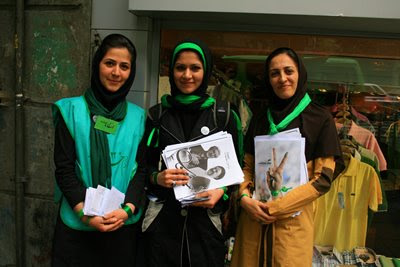
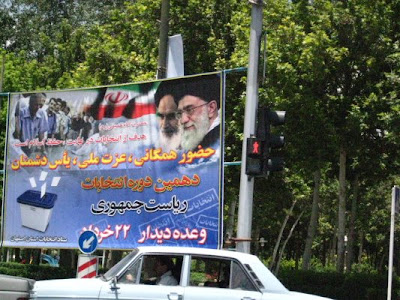
The Iranian election for president is reaching fever pitch, with 70 million people going to the polls on 12 June. Polls say that the reformist candidate, Musavi, will take 60 percent of the vote, ousting the incumbent, Ahmadinejad. Mind you, those figures were given to me by a man wearing a green ribbon, the colour of Musavi's campaign.

Here in Isfahan each night, hordes of young boys on motorbikes tear through the streets waving posters of one of the two main candidates, beeping their horns and shouting slogans.

It's all quite crazy and doesn't feel sinister at all, though last night as we were walking home, we passed a square where a young guy had set up a screen and was broadcasting a debate between the parties and about 100 people were watching until the police came and pulled the sound plug. A lot of people immediately jumped on their motorbikes and nicked off, and we followed suit, but heard the sound coming back on as we walked away, looking for a taxi.

Musavi is running under the one word slogan, 'Change', which has been taken up by the young people and students of Iran. This is an important point as something like 70 percent of the population is under 35.

It does mean, however, that the presidential elections at times resemble student politics, as kids stick posters on cars at the lights, take to flag-waving motorbike cavalcades and tie green ribbons on passers by.

In contrast, Ahmadinejad has history on his side, as it's a rare occurence a president has not served the two terms that they are entitled to undertake. His campaign posters show him in various poses of humility, from sitting on a floor with a notebook and pen to deferring to an old man, head lowered.

Whoever wins, there will still be the Supreme Leader over the top of them, currently the Grand Ayatollah Ali Khamenei. First prize, in Iran, surely comes with conditions.

Curious and curiouser


Curious facts about Iran:

The Sydney Morning Herald website is filtered, but New York Times loads fine.

Chris de Burgh is the only Western artist to have performed in post-Revolution Iran.

Persian (Farsi) is in the top three most common blogger language, as Iranians take to the internet to vent.

Saffron ice cream tastes kind of dusty.

More to come...

Saturday, 6 June 2009

Carpet burns

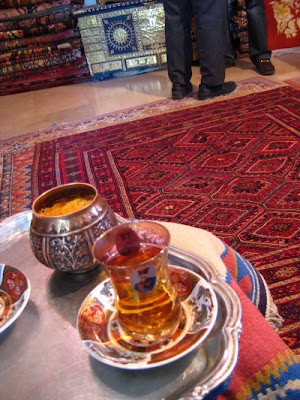
Deep excitement, people! I bought a carpet. Of course. Could you imagine going to Persia and NOT buying a carpet? The total excitement about it is that I am in Yazd, which is a relatively sleepy, though very, very beautiful town made of mudbricks, but local wisdom says that carpets should be bought only in Isfahan.

Now, I haven’t been to Isfahan yet, but their rivals, the Yazdi, say Isfahanis are stingy and would do anything for money. In comparison, the Shirazi don’t like to work, instead preferring to spend life in one long picnic. I’m quite ok with that. I did notice that in a city of allegedly 1.6 million people, there were very few on the streets of Shiraz.

Anyway, back to carpets. So me and my new guide Abdullah were wandering through town once the heat of the day had subsided, took some gorgeous photos of the main square and old marketplace, and were wandering aimlessly through labyrinths of laneways, which are covered in mudbrick domes, when we ran into a nice guide and his driver and were chatting, and I looked over their shoulders, and there it was: the carpet that won one of the top prizes in the European carpet fairs this year.


I saw, I fell in love, I desired. We hit on a mutually acceptable price (two-thirds of his original asking price) and he unpinned the piece from the wall. The owner of the shop, Matris Carpet & Killim Company, is also a direct manufacturer and buys and dyes the wool, has local women weaving it on long, thin looms, and these pieces are then stitched together to make the final product, which is a 2 x 1.5m carpet called a jajeem.

I also didn’t have enough ready money.

Since the US put sanctions on Iran years ago, Iran is a curiously nationalistic city – your plastic bags, soap, cars and even banks are all Iranian, and have no links to the international banking system, save a few big dealers in Isfahan who have circuited the loop by linking up with Dubai banks, so buyers don’t have to think about bringing in an extra US$1000 in cash if they want to some serious carpet shopping.

However, once again, travellers cheques came to my aid – yes, the daggiest form of money around. Less sexy than even the Iranian rial or the Egyptian pound, and that’s pushing it. He took the cheques, I took the carpet. We will both sleep happily tonight.

Wednesday, 3 June 2009

The dust of ancient history


I love Shiraz – deep, red and Australian. But Shiraz the city from which the grapes originated, is nice too. Set in central Iran, the modern city of 1.6 million dwells alongside the ancient seat of power of the great Achaemenid dynasty, Persepolis.

Excavated in the 1930s from the layers of dirt from the encroaching desert and earthquakes that have shaken this land in past centuries, Persepolis is up there with Rome’s ruins, those colosseums on the Greek isles, Egypt’s great monuments… High columns still tower over the plains below, and the faces of lions, bulls and mankind stare into the past.

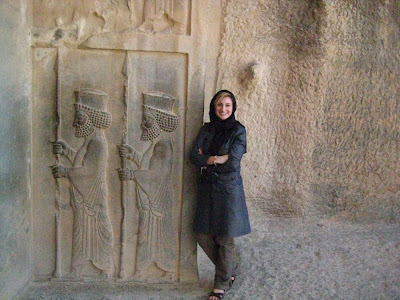
The 2500-year-old site is heavy with symbolism – bulls for protection, eagles for freedom, the griffin for royalty and man… for wisdom. There are sphinxes everywhere – a man’s body with a bull’s head, or with a lion’s head – mounted on columns up to 17 meters high or lining what were grand entrances where foreign ambassadors and local dignitaries entered the Persian court. During its reign, the dynasty’s lands spread from India to the Danube River.

Alexander the Great, that muscular Macedonian who managed to charm countries such as Egypt into giving themselves unto him, was not so charming by the time he hit Persia. He sacked and burnt Persepolis in the 320s BC, after he’d sent a caravan of 30,000 horses and camels back home, carrying the city’s great treasures.
Shiraz is flanked by stony mountain ranges in which the ancient kings of the Achaemenid tribe are buried. High up in a cliff face, their graves are dug deep into the stone, with stories of their empires carved around the portal where their bones were interred after being snacked on by vultures.

I remember the kings’ names from the few periods when I was awake during Ancient History: there was Darius the Great, Xerxes, Artaxerxes and Darius the second, the stars of Herodotus’ ‘The Persian Wars’.

“I fell asleep in Ancient History at school,” I confessed to my guide, the glamorous Yasma.

“So did I,” she confessed.

And together, travel writer and tour guide looked up at the bas reliefs of past wars and hard-won victories, as the swallows flew in and out of the empty tombs far above us.

Monday, 1 June 2009

Hijab hair


Day One in Iran and the novelty of doing a French Lieutenant’s Woman hasn’t yet worn off. By that I mean wearing the hijab, or head scarf, that is compulsory for all females above the age of nine under Islamic law. Actually, nine is an arbitrary age, it really means when a girl reaches maturity.

Sinfully early this morning at customs, I saw a Japanese girl turned back because she hadn’t put her headscarf on while passing the last hurdle to wandering free in Iran. It wasn’t until a businessman in the queue behind her took the lime green scarf from her hand and ever so tenderly tied it under her chin that she was let loose in the country.

Had I known that coloured headscarves are all the rage, I would have brought one of my brightly coloured ones from Cairo. But I opted for black on the advice that muted tones of grey, dark green and blue are most common, and at least half the population wears black. But many other colours, including white and aqua were frequently spotted as my guide Reza and I tottered around Golestan Palace, Tehran bazaar and a former arsenal that is now a cool park with café and art gallery.

As it was, I left my hairdryer at home (who needs to do their hair when it’s covered all day?) but I might run into difficulty when I enter a private home (it’s on the cards) and take my scarf off to reveal… higab hair! Flattened to a pancake, it’s none too flattering, let me tell you after a day under wraps.

Hip Tehran girls tease the life out of their hair, so the fringe stands up like a 60s quiff that their scarf is then draped oh-so casually from. Actually, the boys are doing the same, without the scarf, and long, lush dark hair is gelled into gravity-defying waves that give them another six inches’ height.

As has been well reported elsewhere, nose jobs, once the preserve of the rich, have been around in Iran for at least 15 years, and are now quite common, though I saw only one plastered nose, and that was on a young guy.

The city is very safe, very clean and damned organised, by Cairo standards, though the traffic is a little vicious. If I was coming straight from Australia, it’d be different, but Tehran certainly has its own quirks, not least all the billboards of the mullahs and martyrs of the revolution around the city.

My headscarf just fell off hahahahahah. Lucky I’m sitting on my own little balcony! Signing out from Tehran…